
Safeguarding ideology by terrorizing teachers
A British teacher was labelled a terrorism risk for showing Trump videos—while leftist teaching goes unpunished

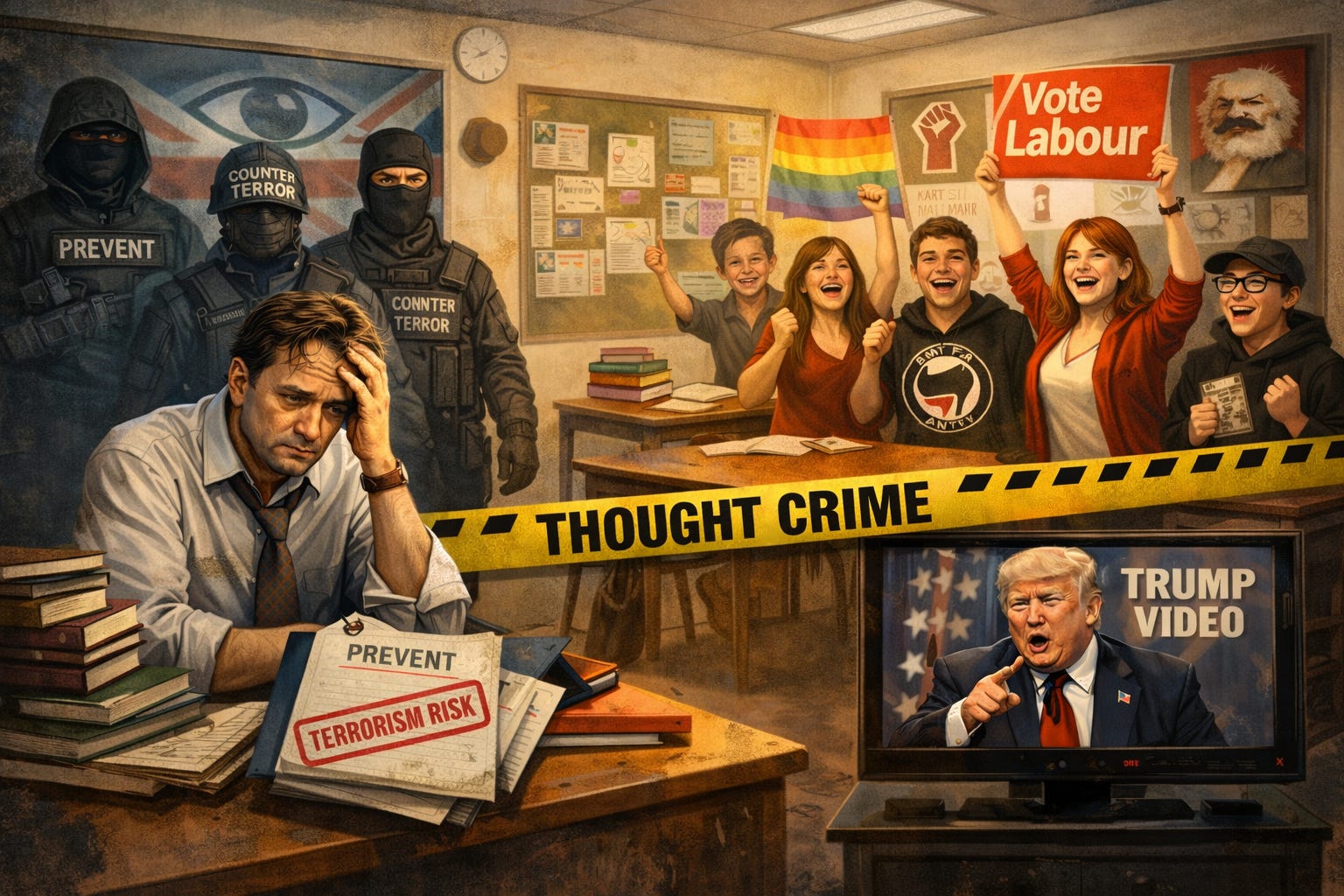
British authorities are abusing “safeguarding” powers—originally designed to stop sexual predators—to punish people for holding the wrong political views, while ignoring partisan teaching so long as it aligns with the approved ideology.
That under-reported pattern now has a new, almost parodic, case study.
A veteran teacher at an English sixth-form college has been fingered as a potential terrorist for showing videos of Donald Trump to students of politics.
Not extremist sermons. Not jihadi propaganda. Not incitement to violence. Videos of a democratically-elected US president — in a class on politics and propaganda.
For this, the teacher was accused of posing a risk to children, referred to safeguarding authorities, and flagged for the Government’s Prevent counter-terrorism programme.
The teacher, qualified since the mid-1990s, taught at Henley College in Oxfordshire, a large sixth-form college (final two grades of high school), with over 2,000 students. His alleged offense was showing several Trump-supporter videos during lessons on US politics and propaganda, even though his content was bipartisan: he showed equivalents featuring Kamala Harris.
Two students complained that his teaching was “biased” and “off topic.” One said a video induced “quite uncomfortable” feelings.
That was enough.
Henley College referred the matter to the Local Authority Designated Officer, who concluded that the case should be treated as a priority Prevent referral.
In documents seen by the Telegraph, officials suggested that showing Trump-supporter videos could amount to “emotional harm,” might constitute a “hate crime,” and raised concerns about “radicalisation.”
Let that sink in.
A teacher discussing a US election with 17- and 18-year-old students of politics is treated as a potential extremist, while schools that bus children to Labour Party conferences, or label supporters of Britain’s most popular party (Reform) as “fascists,” face no safeguarding scrutiny at all.
The teacher (who wishes to remain anonymous) puts it plainly:
“They likened me to a terrorist. It was completely jarring. It’s dystopian—like something from a George Orwell novel.”
That comparison is not hyperbole. Prevent is explicitly a counter-terrorism programme. It was justified to intervene where there are signs of violent radicalisation. Yet here it was deployed against a teacher who aired the views of supporters of a democratically-elected president, as well as his opponent. This was bipartisan, except that the norms of teaching demand Trump supporters are given no exposure at all.
The teacher says of the school: “They don’t tolerate anything about Donald Trump,” due to a “complete Left-wing bias”.
Henley College, which attracts students from Oxfordshire, Berkshire, and Buckinghamshire, said: “We are committed to safeguarding the wellbeing of all our students and staff, and follow statutory safeguarding procedures in line with Keeping Children Safe in Education 2025.”
Except that schools don’t follow statutory guidelines against partisan teaching. They do bend statutory guidelines for safeguarding in order to censor views they don’t like – from adults as well as children.
As with the cases I reported previously, the charge of “emotional harm” does the heavy lifting. Emotional harm is undefined, unmeasured, and infinitely elastic. It requires no criminal standard of proof. It allows officials with no legal training to act as moral arbiters, political commissars, and judge-jury-executioner. And their verdicts are practically impossible to challenge without ludicrously expensive civil action.
In this case, the outcome is predictable.
After half a year of investigation, stress, and formal accusations of misconduct, the teacher was effectively forced out of his job.
After the Free Speech Union’s intervention, he accepted a £2,000 settlement—loose change against a £44,000 salary. He now works as a supply teacher while trying to rebuild his career, aged in his 50s.
Safeguarding rulings are cheap to impose and ruinously expensive to resist.
This case fits into the pattern already established.
