
China spies blame-game implicates everybody
Claims and counter-claims inadvertently prove that everybody conspired to drop the cases against China's spies

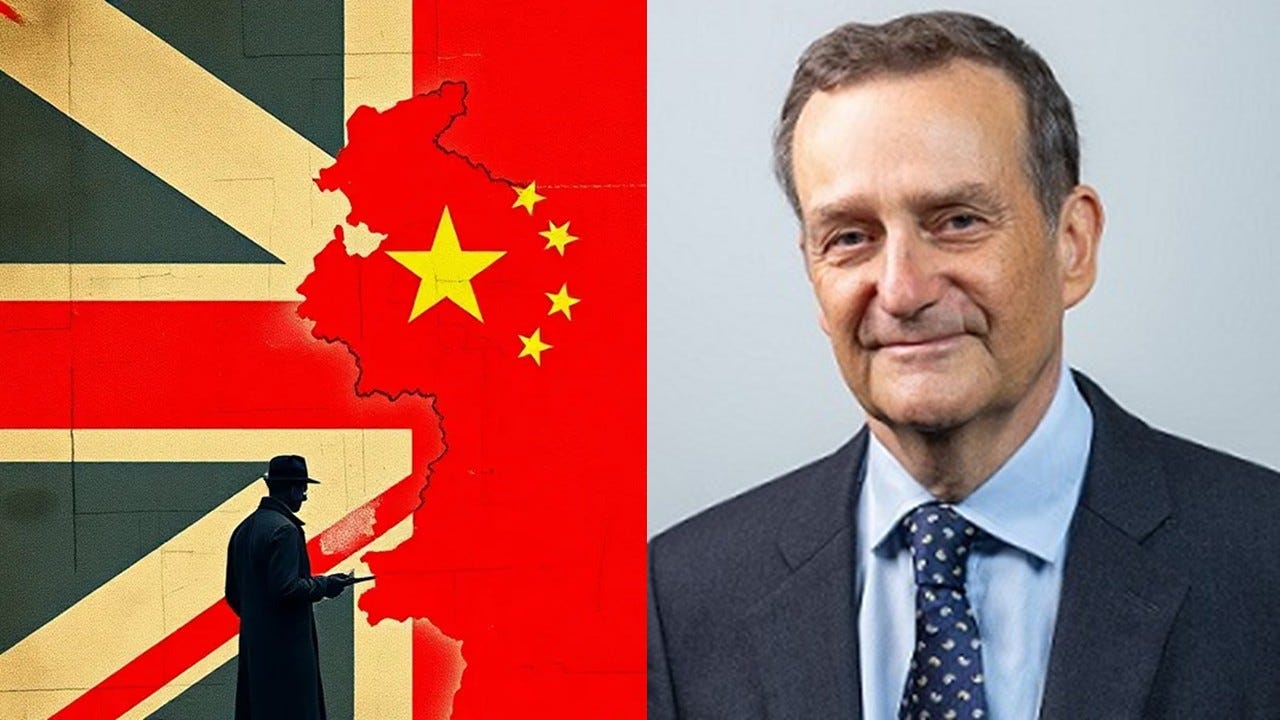
Britain’s chief prosecutor just testified, intentionally but subtly, that the Prime Minister and civil servants colluded to un-prove the cases against two alleged spies in order to appease China. But in the process, he added evidence that the Crown Prosecution Service (CPS) sought an excuse to drop the cases.
Initially, CPS looked like the fall-guy. Keir Starmer’s administration claimed that the CPS had taken the decision on its own, and that the government opposed it. Further, the administration claimed that the CPS had objected to release of the administration’s witness statements. However, the Director of Public Prosecutions (Stephen Parkinson) confirmed that the CPS had objected to release only during an active case, and that the government can release whatever it produces.
Starmer blamed the collapse of the cases on the previous administration’s re-assessment of China as an ‘epoch-defining challenge’ (in 2023, in an integrated review of defence and security).
Starmer claimed that the CPS (which he used to direct) must prove threat at the time the accused (Christopher Berry; Chris Cash) were (allegedly) spying. His Security Minister, Dan Jarvis, claimed the same. Even when Starmer told the Commons he would release the statements, he claimed that they would prove that the previous government is to blame.
However, all the witness statements use the word ‘threat.’ The most relevant is the first, which was submitted to the CPS in December 2023, after Rishi Sunak’s administration released its integrated review, but before it was voted out.
These embarrassments help to explain why the DPP belatedly responded to inquiries from Parliamentary Committees for National Security Strategy, Foreign Affairs, Home Affairs, and Justice.
Notably, he dates the letter to Friday, so that the committees could not release it before Friday night.
The DPP’s letter admits, in answer to a direct question from the committees, that the Sunak administration’s description of China as an ‘epoch-defining challenge’ does not matter: ‘The test was therefore positively not what the then Government was prepared to, or did, say in public about China (whether framed as its policy or otherwise, and whether as a matter of fact true or not), but rather whether China was - as a matter of fact - an active threat to national security.’
Other than Starmer, the DPP is focused on blaming Matthew Collins, who was the Deputy National Security Adviser under Sunak and Starmer. Collins wrote all three witness statements. They use the word ‘threat’ first in a promise to ‘increase our national security protections where Chinese State (CCP) actions pose a threat to our people, prosperity and security.’
Actions are not states, so Collins could be misrepresented as saying China is not a threat, even though its actions could be. But the same section specifies actions that already pose effective threats, including ‘highly capable…espionage.’
The potential misinterpretation is perhaps why, within two months, the CPS asked Collins ‘to amplify a number of the points which were made in my first statement,’ as he writes in his second. Parkinson’s letter explains that Collins ‘was asked if it was possible to say that China was an active threat to national security between 31 December 2021 and 3 February 2023.’
Collins’ second statement declares that ‘China…presents the biggest state-based threat to the UK’s economic security,’ and that three officially-categorized ‘Advanced Persistent Threats’ spied, through cyberspace, from China, on British government and businesses.
Yet the DPP claims that the second statement ‘fell short of answering the question whether at the relevant period China was an active threat to national security.’
So the CPS asked Collins to ‘discuss risks beyond economic risks.’ Collins said, the next day, that he could not elaborate in writing, but is prepared to be cross-examined on the issue. I imagine that Collins was exasperated. Friends of Collins say the CPS told him, at some point, that he had provided what the CPS required.
Months later, the CPS decided, according to its email to the Cabinet Office, that proving ‘active espionage threat would not be sufficient without examples which adequately demonstrate the nature and extent of the threat.’
But Collins had already provided examples, including one of the officials to whom Berry allegedly passed information in China.
Still, perhaps prosecutors weren’t constructing a reason to drop the case; perhaps they were being thorough.
Collins provided a third statement, six months after his second. It largely repeats text from the first. It specifies what one of the APTs did in 2021 and 2022, as ‘a specific demonstration of the active espionage threat.’ Note the word active.
So the witness statements make both the CPS and the administration look like liars.
The administration was incorrect to claim that it could not prove China’s threat from 2021 to 2023. The CPS was incorrect to claim that it could not prove that Cash and Berry passed intelligence to a threat.
The DPP’s letter relates that the CPS must prove, under the Official Secrets Act (which does not contain the word ‘threat’) that ‘the defendants were acting with a “purpose prejudicial to the safety or interests of the State” and that China was an “enemy”,’ during the same period.
But Parkinson’s next sentence admits: ‘The prosecution case was that the “enemy” requirement was met by proving that at the material time China was an active or current threat to the UK’s national security.’
So, a threat is sufficient, under the law.
The strategy was confirmed in May, during the trial of six Romanians for espionage, when the court was persuaded of Russia’s threat, by a witness statement from Collins. The DPP’s letter admits all this, and that the judgment explicitly confirms the case law that enemy is proven by threat.
Yet Parkinson’s letter keeps referring to ‘enemy’, as if to exaggerate the evidentiary threshold.
The DPP makes the curious claim that he realized by August that Collins ‘would not be able to say that, at the time of the offence, China was an active or current threat to national security.’ But Collins already had testified that China was an ‘active espionage threat.’
Surely Parkinson is splitting hairs in order to construct a reason to drop the cases?
Parkinson paraphrases Collins as saying, in August, ‘that he would not state in evidence, if asked, that China posed a risk to our national security,’ or ‘that China was opposed or hostile to the interests of the United Kingdom at the material time,’ and ‘would say’ that the question of whether China was effectively ‘an enemy’ then is ‘a matter for the jury.’
On 9 September, Collins confirmed, according to Parkinson, that ‘he would not say that China was an active threat.’
Parkinson is implying that something had changed in what ministers permitted him to say.
