


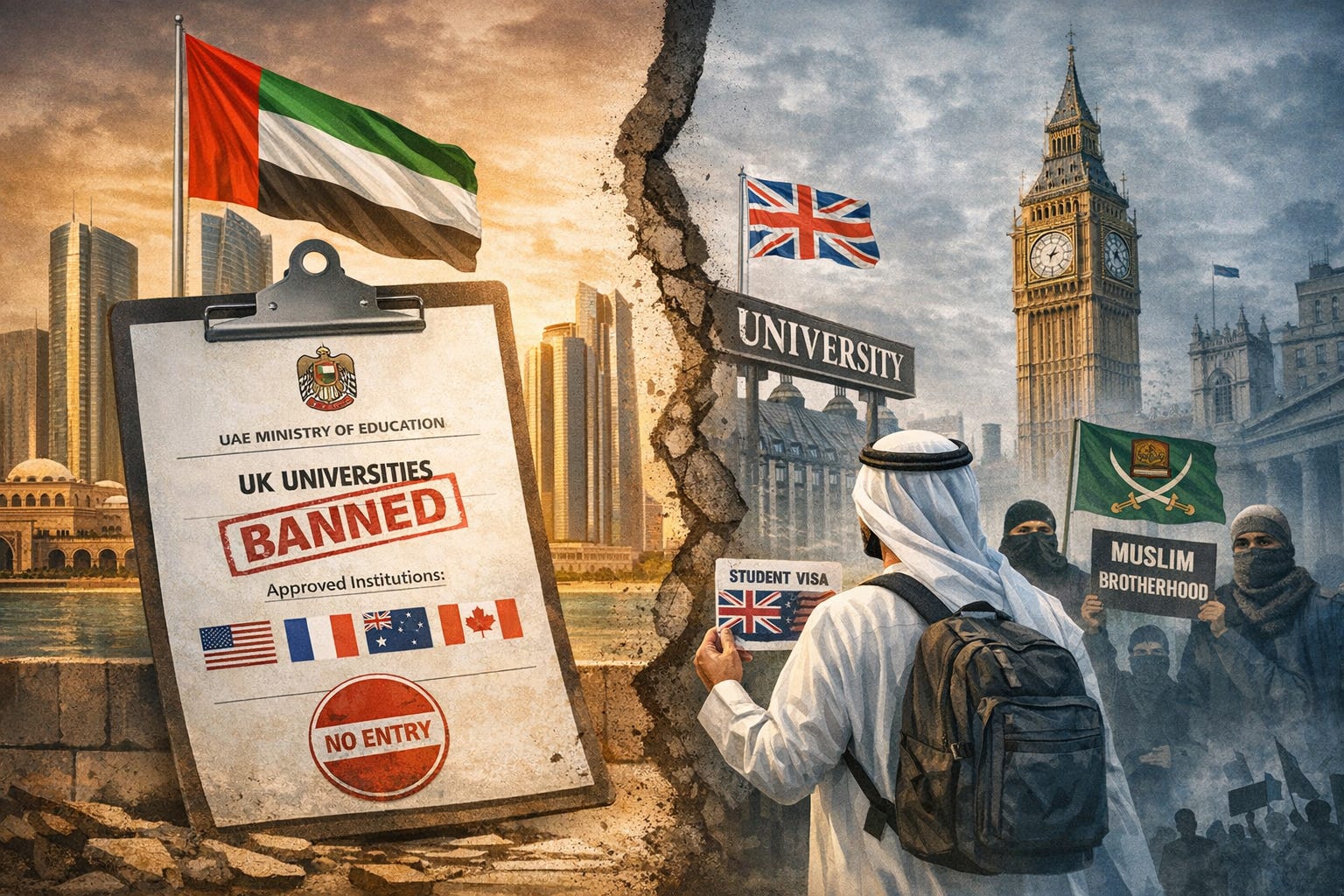
In early January 2026, an unusual foreign memo was leaked to a British newspaper. The United Arab Emirates (UAE) removed British universities from its list of institutions eligible for state scholarships, licenses, and promotions. The decision does not illegalize Emirati study in Britain. But in practice, it functions as a near-ban: studying in Britain becomes financially and professionally risky for most Emiratis.
The Financial Times reports UAE’s decision as aimed to protect Emiratis from Islamists on British campuses, particularly the Muslim Brotherhood, which the UAE has designated a terrorist group, but Britain has not.
Britain’s tolerance of Islamism is now carrying real reputational, diplomatic, and economic costs.
Under revised guidelines from the UAE’s Ministry of Education, British universities are excluded from the government’s approved list of foreign institutions eligible for state scholarships, licensing within the private sector, and promotion within the public sector.
Abu Dhabi’s stated concern is ideological exposure, not academic quality.
UAE officials argue that British universities tolerate Islamist student organisations and speakers that the UAE proscribes, particularly the Muslim Brotherhood.
Britain, by contrast, has repeatedly declined to proscribe the Muslim Brotherhood, citing legal thresholds and civil-liberties concerns.
From the UAE’s perspective, this divergence is not just a matter for Britain. Emirati students abroad are expected to return as civil servants, officers, engineers, and administrators. Exposure to recruiting by terrorists is seen as a national security risk.
The striking feature of the policy change is not just the country the UAE fingered —but the countries it does not: the United States, France, Australia, Canada!
All are liberal democracies. All host controversial political speech. All value academic freedom. All have suffered campus sit-ins in favour of Palestinian sovereignty from the river to the sea. None has banned the Muslim Brotherhood.
So why Britain?
